
Smaller, Longer, Better
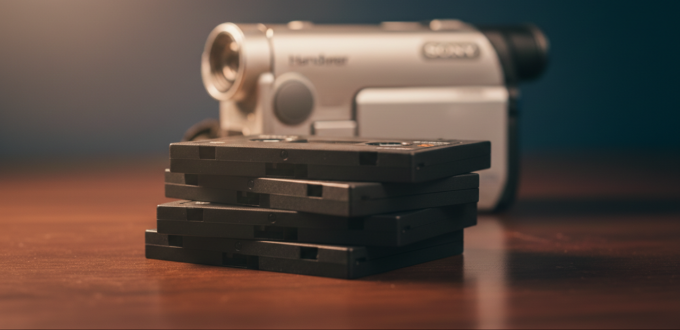
In the mid-1980s, the home video world was dominated by the bulky VHS tape. But in 1985, Sony changed the game by launching the Video8 format. Unlike the massive shoulder-mounted cameras of the early 80s, the 8mm format allowed for the “Handycam”—a device that could fit in the palm of your hand.
Despite its tiny size (about the size of a cassette tape), Video8 was a powerhouse. It offered:
- Longer Recording: Up to 120 minutes of footage on a single tiny tape.
- Higher Audio Quality: Because Sony wasn’t worried about backwards compatibility with VHS, they used an FM audio system that sounded significantly better than standard VHS.
The Evolution: Hi8 and Digital8
As televisions improved, so did the 8mm format. To keep up with demand for sharper images, Sony released Hi8 (High-band Video8) in 1989. This version boosted the resolution to 400 lines—matching the quality of expensive LaserDiscs and even challenging professional broadcast equipment.
By 1999, the final evolution arrived: Digital8. This was a hybrid miracle. It used the same physical 8mm tapes but recorded a high-quality digital signal (DV). Most importantly for families today, Digital8 cameras were often “backwards compatible,” meaning they could play back your old analog Video8 and Hi8 tapes.
[Image Suggestion: Comparison of Video8, Hi8, and Digital8 tape logos]
The 15-Year Clock
While these tapes were revolutionary, they were never meant to last forever. Unlike 8mm film (which can last 50+ years if kept cool), 8mm tape is a magnetic medium with a much shorter shelf life.
- The Danger: Experts estimate that magnetic tapes begin to degrade significantly after 15 to 20 years.
- The Symptoms: If you see “snow,” horizontal lines (tracking errors), or muted colors when playing your tapes today, that is the magnetic particles literally falling off the plastic backing.
Why Preservation is Critical
The 8mm format didn’t just record movies; it recorded the 90s. From first birthdays to graduation ceremonies, a whole generation’s history is locked on these small plastic cassettes.
Because 8mm camcorders are no longer manufactured and parts are becoming rare, simply “owning a camera” isn’t enough to save your footage. At Digital Media Now, we use professional-grade decks and Time-Base Correctors (TBC) to stabilize the signal from aging 8mm tapes, capturing them in uncompressed formats before converting them to high-bitrate digital files.
Don’t let the “Format War” winners be the ones who lose their memories. If you have a box of 8mm, Hi8, or Digital8 tapes, the time to digitize them is now—before the magnets fade for good.