
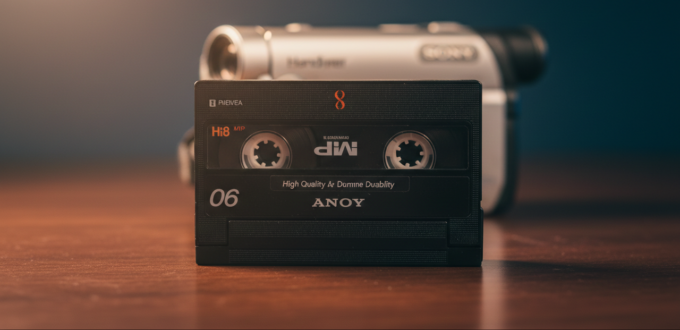
The Millennium Hybrid
In 1999, as the world braced for the digital millennium, Sony released the final and most sophisticated evolution of the 8mm family: Digital8.
While other digital formats like MiniDV required entirely new, smaller tapes, Digital8 was a genius engineering feat. It allowed users to record a high-quality digital signal onto the exact same analog Hi8 tapes they had been using for years. It was the perfect “bridge” technology, allowing families to step into the digital age without throwing away their existing collection of tapes.
How Digital8 Works
The “magic” of Digital8 was in how it handled data. It used the industry-standard DV codec—the same high-quality compression used by professional filmmakers and MiniDV cameras.
- Resolution: It offered a massive jump to 500 lines of horizontal resolution (compared to the 240 lines of original Video8).
- Audio: It introduced crystal-clear PCM Digital Stereo, eliminating the “hiss” and background noise of older analog recordings.
- Speed: To fit this much digital data onto an 8mm tape, the camera actually spun the drum and moved the tape at double the speed. This meant a standard 120-minute Hi8 tape would provide 60 minutes of high-quality Digital8 recording.
[Image Suggestion: Sony Digital8 Handycam showing the “Digital8” and “Hi8” logos together]
The “Backwards Compatibility” Game Changer
The biggest selling point for Digital8 was its ability to look into the past. Sony designed most Digital8 HandyCams to be backwards compatible. This meant:
- You could record new memories in 100% digital quality.
- You could put your old analog Video8 and Hi8 tapes from the 80s into the same camera, and it would play them back perfectly.
- The FireWire Miracle: Because these cameras had a digital “i.Link” (FireWire) port, you could use a Digital8 camera to stream your old analog tapes directly into a computer as digital data—making it the first truly easy way for home users to digitize their own history.
Note: Not all late-model Digital8 cameras supported analog playback, making the early-2000s models highly sought after by preservationists today.
Why Digital8 Needs Professional Transfer Today
Even though Digital8 is “digital,” it is still stored on magnetic tape. This creates a unique set of risks:
- The “Digital Dropout”: On an analog tape, degradation looks like “snow.” On a Digital8 tape, degradation causes the image to “pixelate” or disappear entirely because the computer can no longer read the 1s and 0s.
- Format Obsolescence: Sony stopped manufacturing Digital8 equipment in the mid-2000s. Finding a working, well-maintained head to read these high-speed tapes is becoming increasingly difficult.
At Digital Media Now, we treat Digital8 as a “bit-for-bit” transfer. We don’t just “film the playback”; we extract the raw digital data from your tape to ensure your MP4 files are an exact clone of the original recording—no quality loss, no extra compression, just your memories as they were captured.
If you have Digital8 tapes in your collection, they represent the peak of 8mm technology. Don’t let those bits fade away—let us help you preserve them in a modern, shareable format.