
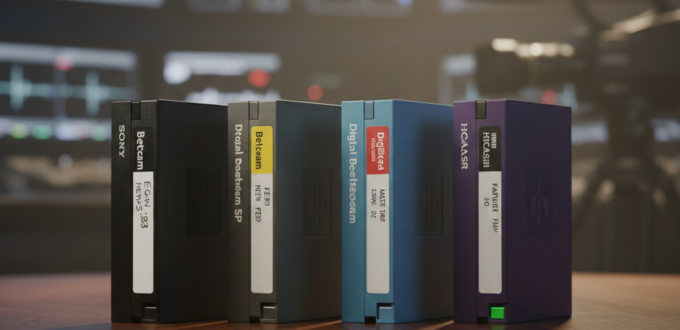
The Original Pioneer
Long before the VHS became a household name, there was Betamax. Released by Sony in 1975, Betamax was the world’s first truly successful home video recording system. For the first time in history, families didn’t have to plan their lives around a TV schedule—they could “Time Shift” and record their favorite shows to watch later.
Why Enthusiasts Chose Beta
In the early days of the “Format War,” tech-savvy users and movie buffs almost always chose Betamax over VHS. There was a simple reason: Quality.
- Superior Resolution: Betamax offered a sharper picture (roughly 250 lines) compared to the slightly blurrier 240 lines of early VHS.
- Stable Image: The way the tape was wrapped around the internal drum in a Betamax player (the “U-Load” system) resulted in a much more stable image with less “jitter.”
- Compact Size: A Betamax tape was significantly smaller and easier to store than a bulky VHS cassette, yet it felt more rugged and professionally built.
The Famous Format War
If Betamax was better, why did it lose? It came down to recording time. Early Betamax tapes were limited to one hour—plenty for a TV show, but not long enough for a Hollywood movie or a game of football. VHS arrived shortly after with a two-hour capacity. By the time Sony increased the recording time, the “VHS Bandwagon” was already too far ahead to stop.
While Betamax stopped being the “standard” by the late 80s, Sony continued to produce the tapes and players all the way until 2002, proving just how loyal the Beta fan base really was.
The Danger: Why Your Beta Tapes are at Risk
If you have Betamax tapes in your cupboard today, they are likely between 30 and 45 years old. This makes them some of the most “at-risk” media in our archives.
- Magnetic Fading: Because Betamax uses a very fine magnetic coating to achieve its high quality, it is highly susceptible to “remanence loss” (the fading of the magnetic signal).
- Mechanical Failure: The internal gears and “spools” in a Betamax tape are more complex than a VHS. Over time, the lubricants inside can dry out, causing the tape to snap the moment it is played in an old VCR.
Preserve Your High-Quality Memories
At Digital Media Now, we have a deep respect for the Betamax format. Because it was a higher-quality analog signal to begin with, a professional transfer of a Betamax tape often looks significantly better than a VHS transfer.
We use well-maintained, high-end Betamax decks to ensure your tapes are handled with the care they deserve. We bypass the internal tuners of the players to capture the cleanest possible signal, converting your high-fidelity Beta memories into modern, 1080p-ready digital files.
Your Betamax tapes were the “Gold Standard” of their time. Don’t let those high-quality memories disappear. Let us help you bring them into the digital age.